Workforce Intelligence: Trading the Rear-View Mirror for a Windshield
Most of how we run our teams is built on looking backward. The annual engagement survey. The quarterly turnover report. The post-mortem we run after someone has already resigned. Each one is useful. Each one is also a rear-view mirror.
Here is the tension for people leaders in 2026: the data telling you what already happened has never been cheaper or more abundant, yet the decisions that matter most are all about what happens next. The World Economic Forum's Future of Jobs Report 2025 found that employers expect 39% of workers' core skills to change by 2030, and that 63% of employers already name the skills gap as the single biggest barrier to transformation. You cannot navigate a shift that large by reading last year's report. You need a windshield.
That is the promise of workforce intelligence: not a better rear-view mirror, but the ability to see risks, gaps, and opportunities before they land. It was the theme of our most recent First Tuesdays Mastermind, and it is worth unpacking in the open, because the frameworks are simple and the shift is overdue.
The reframe: hindsight, insight, foresight
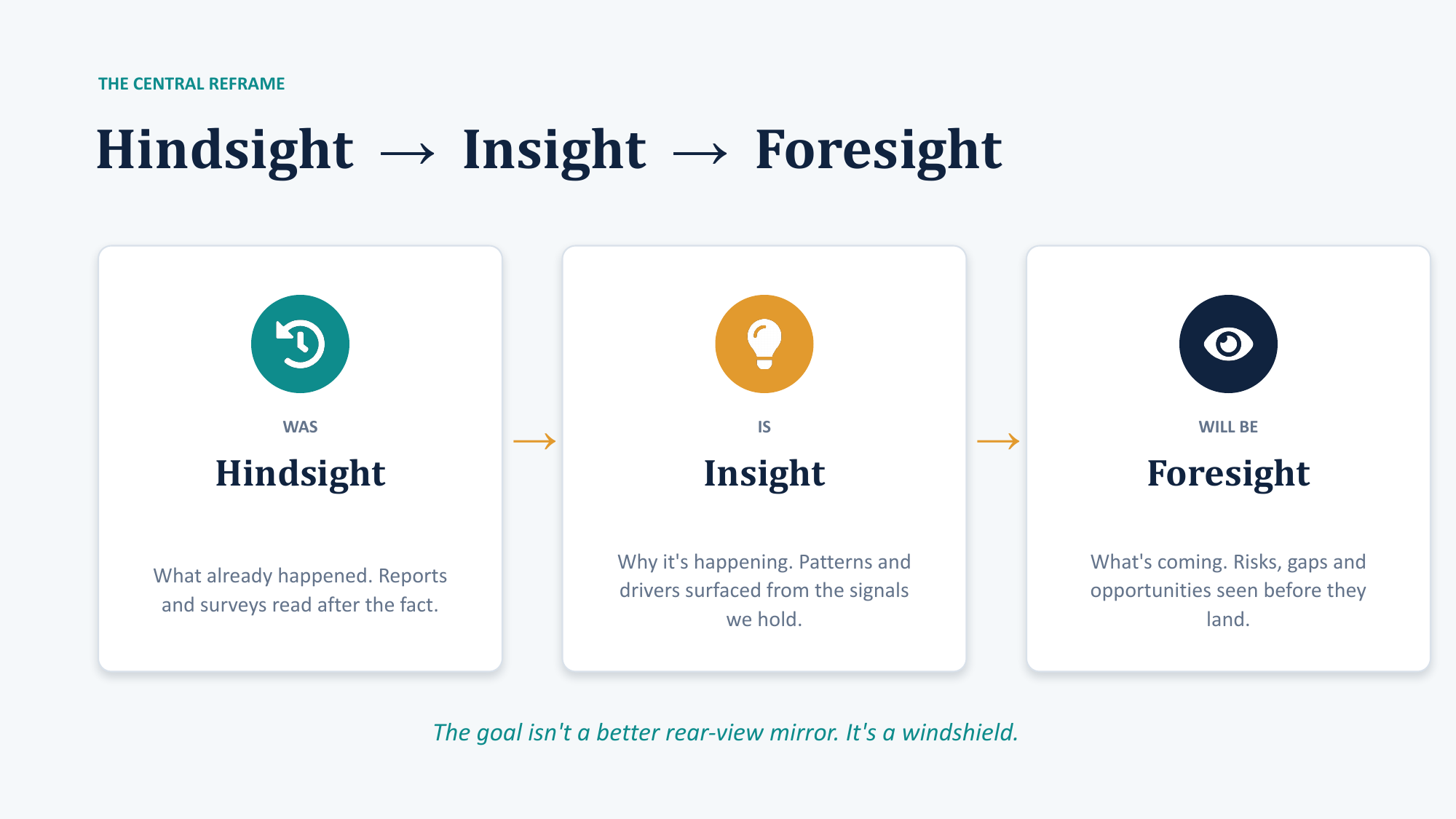
Start with the core idea. Traditional people reporting lives in hindsight. It tells you what happened. Insight is the next step: understanding why it happened, by surfacing the patterns and drivers in the signals you already hold. Foresight is the goal: seeing what is coming while there is still time to act.
The reason this matters is not academic. Gallup's State of the Global Workplace reported that global employee engagement fell to 21% in 2024, and that the decline was driven largely by managers, whose engagement slipped from 30% to 27%. Gallup estimates that low engagement costs the world economy roughly $438 billion in lost productivity. By the time an annual survey confirms a drop like that, the moment it measured is long gone and your best people may already have one foot out the door. Foresight is the difference between reacting to that number and preventing it.
The analytics maturity ladder
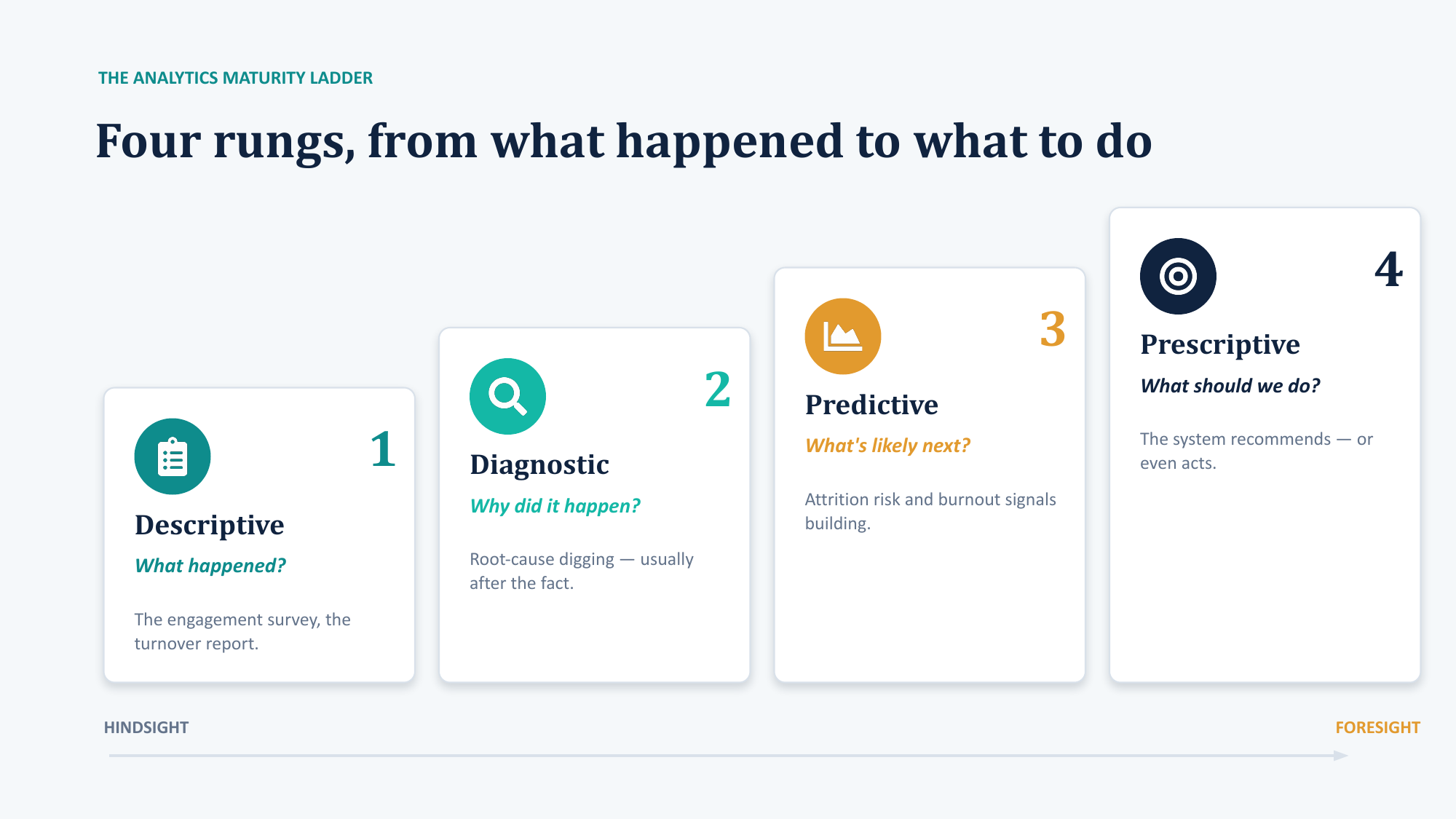
There is a well-worn model, widely credited to Gartner's analytics ascendancy work, that turns this reframe into four rungs. Descriptive analytics answers "what happened." Diagnostic answers "why did it happen." Predictive answers "what is likely next." Prescriptive answers "what should we do," where the system recommends an action or even takes it.
Here is the uncomfortable part, and the honest question we put to the room: where does most of your decision-making actually sit on that ladder today? For most teams, most of the time, the honest answer is rung one. That is not a personal failing. It reflects where the technology, the data access, and the skill sets have historically lived. It is also why the higher rungs feel out of reach: analytics research suggests only around 13% of organizations reach the most advanced, prescriptive stage, according to figures attributed to Gartner. The opportunity is not to leap straight to the top. It is to climb one rung.
Frame one: lagging versus leading indicators
Two simple frames make this practical. The first is the difference between lagging and leading indicators. Picture the car again. The rear-view mirror shows lagging indicators: the annual engagement score, turnover after it has happened, exit-interview themes, time-to-fill once the seat is already empty. They tell you something dropped after it dropped.
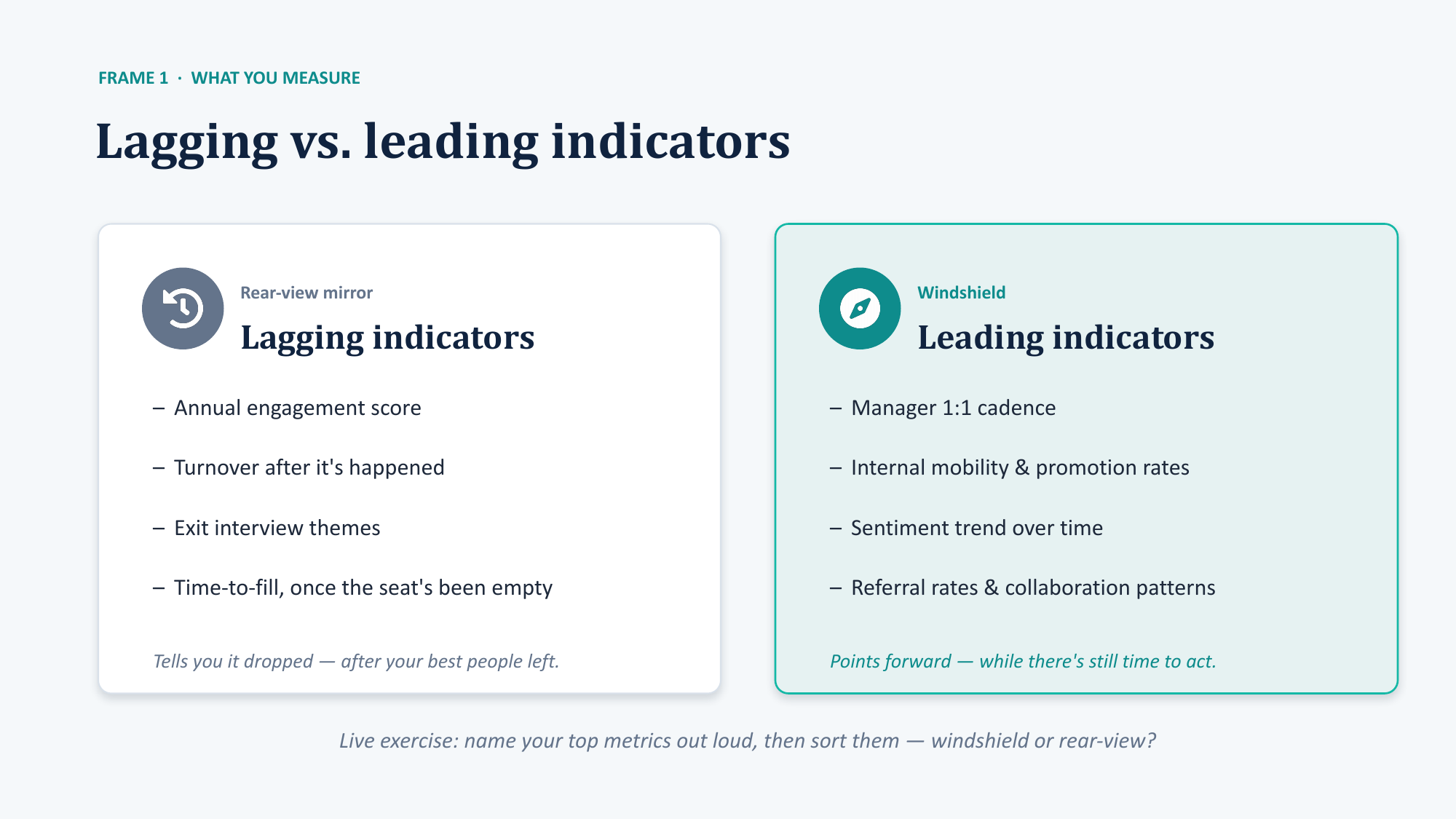
Leading indicators point through the windshield: manager one-on-one cadence, internal mobility and promotion rates, sentiment trend over time, referral and collaboration patterns. These are the signals that give you a real outlook on what is coming. The catch, as several leaders in the session pointed out, is access. Most organizations have no reliable way to capture what happens inside a manager's one-on-ones, and asking a leader to self-report it rarely works. That gap is exactly where the newest tools are starting to earn their keep.
Frame two: a snapshot versus a film
The second frame is about how often you look. The annual survey is a snapshot: one frozen moment, taken once a year, then treated as truth for the next twelve months. We all know its traps, including the town-hall effect, where a survey fielded right after an all-hands reads artificially high.

Continuous listening is a film: an always-on ecosystem of light-touch pulses, lifecycle moments like onboarding and promotion and exit, and the ambient signals already flowing through the organization. The useful distinction here is solicited versus unsolicited signals. Solicited signals come from asking, through surveys and pulses. Unsolicited signals are already there, in meeting load, one-on-one frequency, ticket themes, and mobility trends. The foresight move is reading the ambient ones continuously, rather than interrupting everyone once a year.
What makes this a 2026 conversation
None of this is brand new. What is new is what AI now does with all of it. For years, the richest data in the building, the thousands of free-text comments in an engagement survey, went unread because nobody had time to read it. Today AI themes and summarizes that open text in seconds, which means the "why" is finally as accessible as the "what."
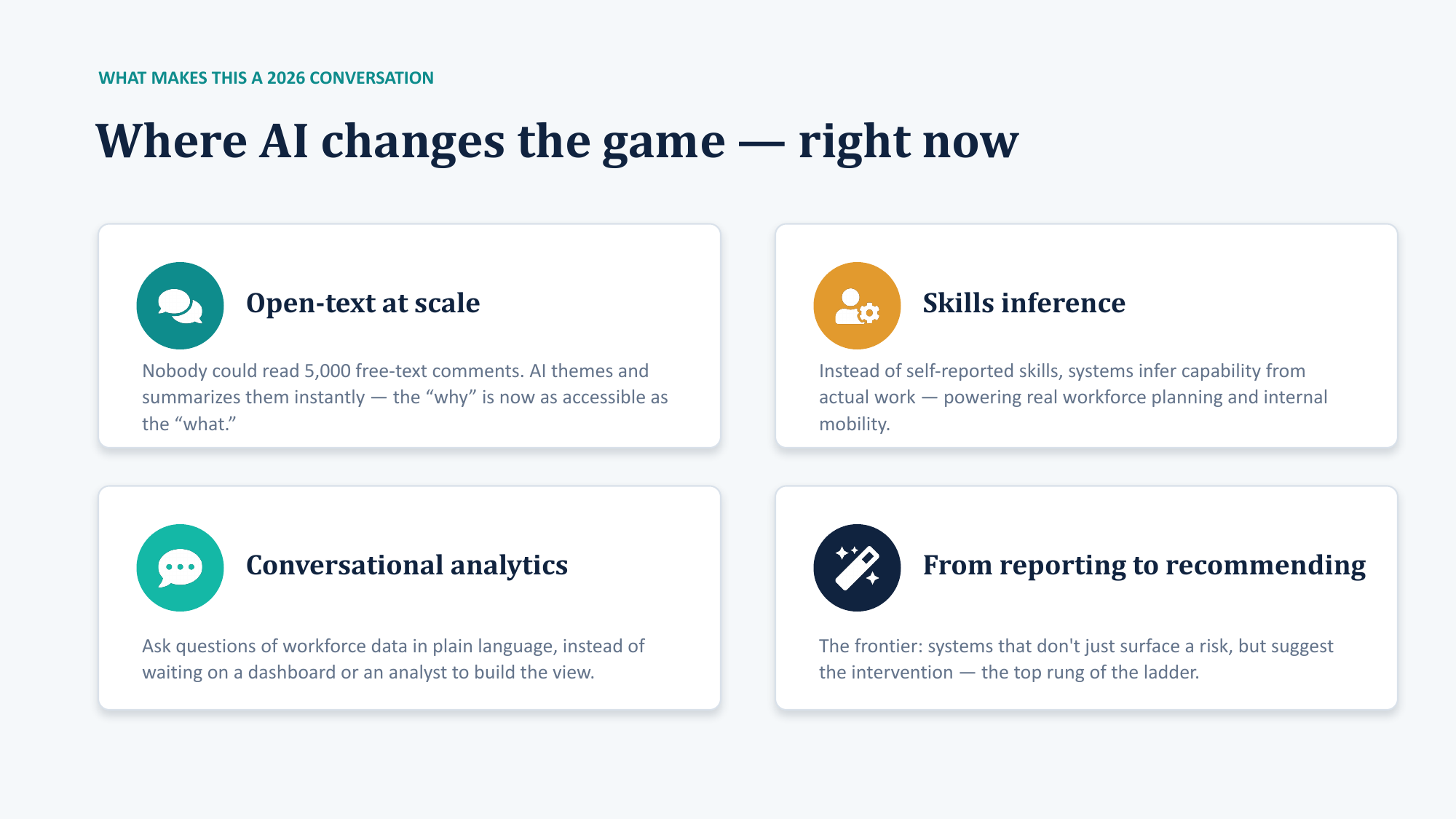
Three other shifts stood out. Skills inference lets systems infer real capability from actual work rather than self-reported skills, which powers genuine workforce planning and internal mobility. Conversational analytics lets a leader ask questions of workforce data in plain language instead of waiting on a dashboard or an analyst. And the frontier is the move from reporting to recommending, where a system does not just flag an attrition risk but suggests the intervention. That is the top rung of the ladder, arriving faster than most people expect.
The wider workplace is already tilting this way. Microsoft's 2025 Work Trend Index found that 82% of leaders expect to use digital labor to expand workforce capacity within the next 12 to 18 months, even as 80% of the global workforce reports lacking the time or energy to do their work. Capacity is the constraint, and intelligence on demand is how leaders are trying to close the gap. People teams that learn to read their own signals well will be far better positioned to guide that shift than those still waiting for the annual report.
39% of workers' core skills are expected to change by 2030, per the World Economic Forum's Future of Jobs Report 2025. Planning for that shift is a foresight problem, not a hindsight one.
What this looked like in the room
In the session, Zech Dahms walked a small group of people and HR leaders through these frameworks and then, as always, opened the floor. The most valuable part was not the models. It was hearing where each leader's decisions actually sat on the ladder, and what signal their business was already generating that they were not yet reading.
One thread that surfaced was the idea of "seams," the gaps that sit between the rungs. Instead of asking only what happened, the group traded sharper questions: where is a competitor slow, and where are they ahead of you? Where has a customer quietly accepted something they do not actually like? Where does a rule exist that nobody in the building can explain? Those questions are how you move from describing the past to acting on the future, and they are the kind of practical, peer-tested thinking these sessions are built to produce. We keep the specifics of the room private, but the frameworks are yours to use.
The goal is not a better rear-view mirror. It is a windshield. Stop steering by what already happened, and start building foresight one signal at a time.
Where to start this month
You do not need a people-analytics team or a big platform investment to begin. Start by listing your top people and business metrics and sorting each one: windshield or rear-view? Most lists come out almost entirely rear-view, and that realization is the point. Then pick one leading indicator you could actually track, and one ambient signal you are already generating but not yet reading. Climb one rung. That is workforce intelligence in practice.
Think through this with other people leaders
Workforce intelligence is exactly the kind of topic that gets sharper in a room full of people who are wrestling with it too. The Achieve Leadership Network brings HR and people leaders together each month to unpack frameworks like these, coach each other through live challenges, and turn ideas into action. If reading your own signals better is on your list for the back half of the year, this is a good place to do the work.
Learn more about the Achieve Leadership Network
Sources cited
- World Economic Forum, Future of Jobs Report 2025 (39% of core skills changing by 2030; 63% cite the skills gap).
- Gallup, State of the Global Workplace 2025 (global engagement 21% in 2024; manager engagement 30% to 27%; ~$438B productivity cost).
- Gartner analytics ascendancy / maturity model (descriptive, diagnostic, predictive, prescriptive), as described by DataForest and Metrica (around 13% reach prescriptive).
- Microsoft, 2025 Work Trend Index (82% of leaders expect to use digital labor within 12 to 18 months; 80% lack time or energy).

.png)