Revitalize Business with Culture Performance and Retention in 2026
.png)
CPR for Organizational Performance: Revitalize Your Business in 2026
AI, inflation, political strife, and generalized economic uncertainty are creating challenges and opportunities for companies everywhere. But is your organization healthy enough to survive and thrive? Do you even organizational resilience, bro? Let’s talk about organizational CPR.
Everything is out of control these days.
Out of control in the best and worst possible ways, mind you. With enough money and an Amazon Prime account, you can get everything (including washboard abs), everywhere, all at once.
But money ain’t what it used to be (and neither is Amazon Prime).
In business, AI is an opportunity to be sure.
But I’m not the only one who noticed that actually taming and cajoling these soulless LLMs into profitable use cases is more elusive than the market initially thought.
The point is, too many things are beyond our control and it’s tempting to act as though we as practitioners, leaders, operators, and owners have no agency.
In a world where AI robots are coming to take our jobs and eat our prescription medications, how can we be expected to implement performance management best practices, cultivate a high-performance culture, fix middle manager burnout and all the other stuff swirling around our inboxes?
You can’t control the economy, the weather, or the NBA finals, but you can build an organization that is fine-tuned to survive the worst storms and flourish when the sun breaks through.
Ok, but how? How do you hardwire that kind of resilient, adaptive organizational performance into your corporate DNA?
Well, lucky for you, we at Achieve have been thinking long and hard about just that problem.
What Are the Foundations of Healthy Organizational Performance?
We firmly believe that an organization is a living thing. And like any living thing, it has vital signs that tell us whether it’s healthy, sick, or in some cases on life support. We’ve identified these vital signs and codified them into a handy framework we’re calling CPR.
The CPR Framework
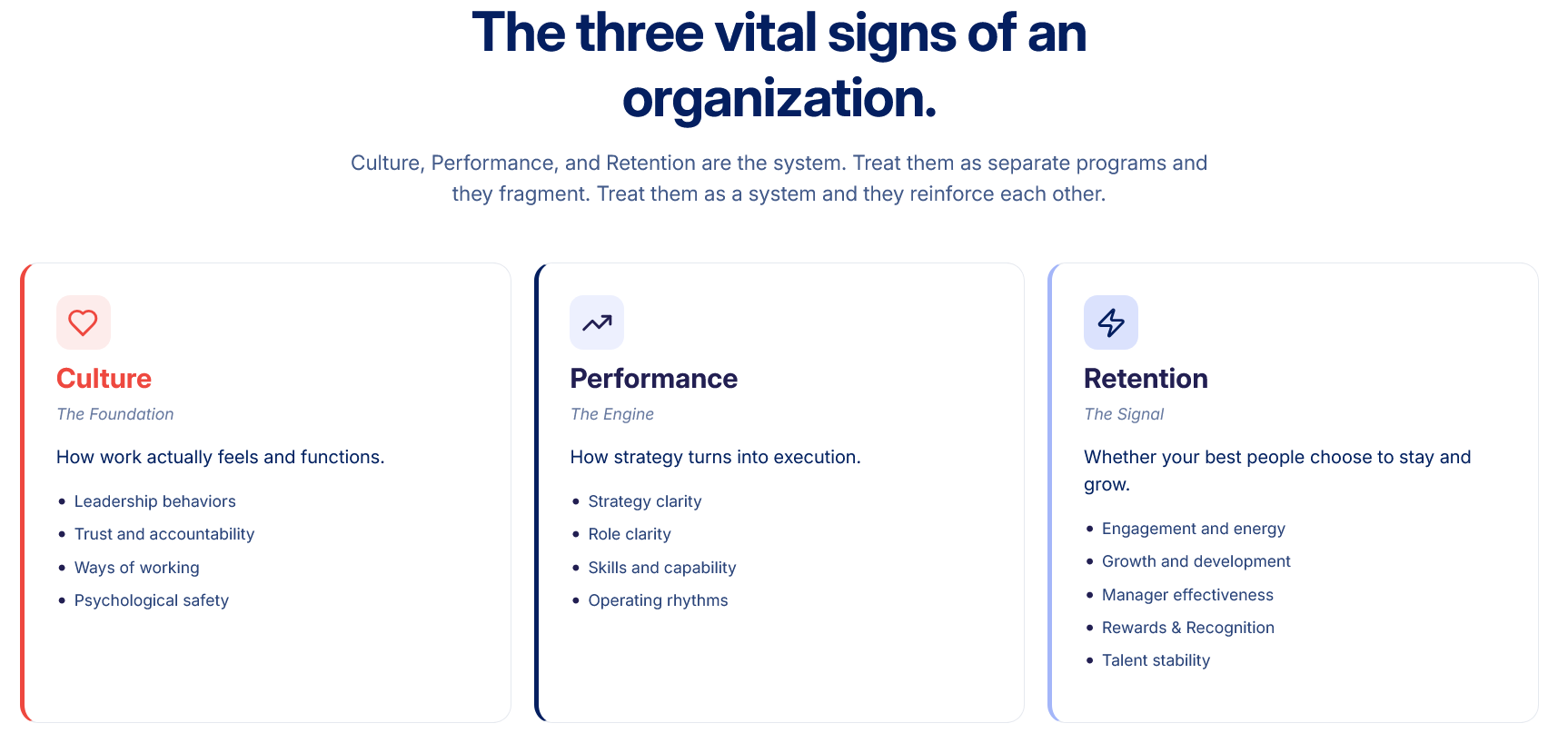
Three vital signs, one system. Get them right and they are mutually reinforcing. Ratchet up one at the expense of the others and your organizational health is in danger.
For example, an organization with a toxic culture that invests heavily in the tools, processes, and skills of performance, may get business results in the short term. But, as the organizational culture suffers, so too will retention and ultimately performance.
What does a healthy organizational culture look like today?
One of the more exciting things I hear in interviews with both solution providers and HR practitioners is that business leaders (some of them at least) are seeing the need to focus more on the human side of the equation.
“We're starting to see more of our CFOs and our CEOs take an interest here and that is a win for HR.” - Hanna Yardley, Chief People and Culture Officer, Achievers
This matters because it is leaders that set the tone for organizational culture.
At our recent CPR live workshop in Atlanta, we heard from seasoned HR leaders on this topic.
Here’s just a few takeaways on culture:
- Cori Nelson, People and Culture Partner at HiBob explained how their leadership development experiences are intentionally infused with company values and actionable sessions on how to put those values into practice.
- Building a healthy, productive culture is an art and a science - the look, feel, and vibe should be authentic and organic, but you also need a system that connects behaviors to values and values to strategy (h/t to Robin Hendricks, Head of Talent Azmara Cruises)
How are smart organizations driving performance?
This is where things get tricky.
As Zech Dahms, President and all around great guy at Achieve is fond of saying, “If you have a business where everyone is happy, no one leaves, but no one is performing either and ultimately you have a really happy organization that’s actively going out of business.”
High-performance is a non-negotiable, but we all know you can’t get there by buying performance management software, and setting a few goals once or twice a year.
Here’s a few more things we learned in Atlanta (click here to sign up for the free "watch party"):
- High performance is a way of being and a set of conditions you design for, not an outcome and or a person - Kamaria Scott
- Pay people for the behaviors you actually want. If collaboration or customer service are going to improve your bottom line, factor that into the way you compensate your people.
- Don’t neglect your middle managers, they’re crucial to shaping culture, engagement and performance and a lot of them are burning out.
- The best coaching and feedback happens in the moment (an oldie but a goodie)
How do we engage and retain our best people?
It’s easy to become mono-maniacally focused on retention as an outcome. Don’t get it twisted. You can’t run a business when people are leaving in droves. But 100% retention isn’t exactly a sign of organizational health either.
If someone is incompetent or fundamentally misaligned with company strategy, should we actively be working to retain them? It doesn't sound like the stuff of award-winning employee engagement strategies does it?
The plan should be to keep your best people engaged and productive over the long term.
Best practices and technology for engagement and retention are evolving quickly:
- Major recognition and rewards programs are getting serious about leveraging decades of data to not only predict regrettable attrition but identify and quantify the types of behaviors that drive organizational performance
- Compensation strategy tools are getting in the game of retention management too by helping organizations identify and address pay gaps that reduce the resentment that comes from being underpaid relative to peers or the marketplace in general
Finally, here’s a few more nuggets of wisdom from the Atlanta CPR live event:
- The best companies can lose great talent and still stay connected with them. That kind of alumni network is worth much more than being able to say you never lost a high performer (h/t to Lynnette Barksdale)`
- Reactive tactics do not scale. Build healthy systems of recognition, career growth, and engagement, the retention you want will follow from that (h/t to Maggie Brady, VP of HR & Talent, White Cap)
Build an Environment Where Great Work Happens
The essence of the CPR framework is a principled stand against trend chasing, hype, and techno-babble. We care about what works. Technology and processes are tools, use them if they’re useful. But the biggest value is always in creating spaces where humans can be brilliant at what they do every day. And that’s where CPR wants to help.
If you missed the Atlanta CPR workshop, sign up for the watch party
If you want to attend the next live workshop (highly recommended) find out where Zech and the gang are coming next.






.jpg)
.jpg)